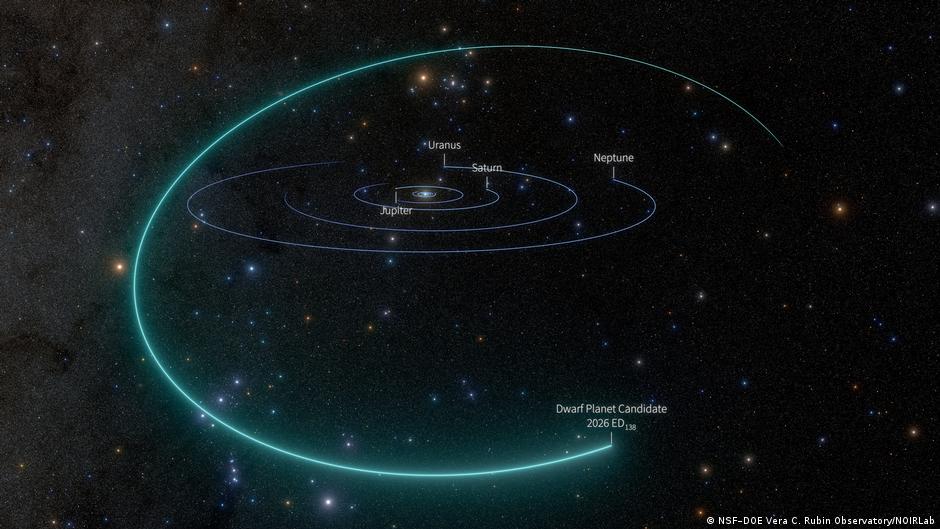
Astronomers have identified a frozen object in the outer solar system that may qualify as a new dwarf planet, DW.com reports. The body, designated 2026 ED138, was picked out from observations made with the Vera C. Rubin Observatory on Cerro Pachón in Chile. It is currently about 46 astronomical units from the Sun — roughly 46 times the average Earth–Sun distance — placing it beyond Pluto, which orbits at an average of about 40 astronomical units.
According to DW.com, early estimates put the object's diameter somewhere between 600 and 1,500 kilometers. On the figures available so far, it ranks among the largest dwarf-planet candidates yet found beyond Neptune.
Why it matters
The International Astronomical Union, the body that formally classifies celestial objects, currently recognizes five dwarf planets: Pluto, Eris, Haumea and Makemake, all of which circle the Sun beyond Neptune, and Ceres, which sits in the main asteroid belt between Mars and Jupiter. If 2026 ED138 is confirmed, it would become the sixth.
The find also illustrates what the Rubin Observatory was built to do. The facility is a joint project of the U.S. National Science Foundation and the U.S. Department of Energy, and DW.com describes it as designed to survey the sky in enough detail to turn up many objects that have so far gone unseen.
The location of the discovery is notable in itself. The object had been hidden in a crowded patch of sky near the plane of the Milky Way, where vast numbers of stars provide a bright background. According to DW.com, that abundance of light sources probably kept earlier telescopes from picking it out.
How the object surfaced
The detection came on October 13, when astrophysicist Matthew Holman was reviewing observations gathered earlier in 2026. He was working with software he developed alongside colleague Kevin Napier, which sifts through billions of detections of moving objects and groups those that belong to the same body.
Once the object stood out, the researchers went back through older images and found records reaching as far back as 2016. That archive let them reconstruct more than a decade of its orbital path.
Holman, of the Harvard-Smithsonian Center for Astrophysics, said the result caught him off guard. DW.com reports that his first reaction was a blend of excitement and disbelief, and that given how rarely such objects appear, he began by checking whether he had made a mistake in his calculations or in the identification software.
"For me, this shows that there are still many exciting discoveries to be made with the Rubin Observatory and other telescopes," Holman said, according to DW.com.
What still needs measuring
The dwarf-planet label is not yet settled. To earn it, a body must carry enough mass for its own gravity to pull it into a roughly spherical shape. 2026 ED138 appears to have the necessary mass, but astronomers say more observations are needed, particularly of its physical size and other properties.
"The main thing we need to do is determine the physical size of 2026 ED138," Holman said, per DW.com.
He explained the difficulty: Rubin sees sunlight bouncing off the object, and a small, bright body reflects the same amount of light as a larger, dimmer one. Observing at longer wavelengths with a facility such as ALMA — the Atacama Large Millimeter/submillimeter Array, a radio telescope also based in Chile — should allow researchers to catch the object's own emitted light, which helps pin down its dimensions.
The discovery was announced at a scientific meeting in Spokane, Washington, where Holman presented the results together with Mario Jurić, lead scientist for the solar system area at the Rubin Observatory, according to DW.com.
The finding adds to a run of results from Rubin. In April 2026, the team had already reported observations of more than 11,000 new asteroids, including about 380 trans-Neptunian objects. The observatory is set to keep scanning the southern sky repeatedly over a decade, a campaign that could reveal further unknown bodies.
Pluto's own history frames the stakes. It spent decades as the ninth planet and the most distant one known, until the IAU reclassified it as a dwarf planet in 2006 on the grounds that it did not meet the organization's formal definition of a planet.
Watch for follow-up observations, especially with ALMA, aimed at fixing 2026 ED138's size — the measurement that will decide whether it joins the list.